
Eight champions, a historic second absolute title for Felipe Pena, and a 14-year-old medalist: here's what happened across both days of ADCC 2026 in Krakow, including a bronze medal for Paige Ivette Clymer, who taught at The Garden's 2.0 camp.
ADCC 2026 World Championship Recap: Day 1 and Day 2 Results, Upsets, and Lessons for the Mat
The ADCC 2026 World Championship is in the books. Over two days, September 12 and 13, 104 of the world's best submission grapplers competed at Tauron Arena in Krakow, Poland, across five men's divisions and three women's divisions. Day 1 covered the opening rounds and quarterfinals. Day 2 brought the semifinals, the medal matches, the superfight, and the absolute. By Sunday night eight division champions had been crowned, and one of the athletes on the podium once taught on our mats.
For newer students: ADCC (Abu Dhabi Combat Club) is the most prestigious submission grappling tournament in the world. It runs every two years, invitation-only, with a ruleset that rewards finishing. Points don't begin until the second half of regulation, which means athletes must either submit their opponent or create clear positional dominance. Pulling guard without a submission attempt draws a penalty. It's the closest thing no-gi jiu jitsu has to a World Cup, and it's the tournament that shapes how the competition meta evolves for years afterward.
The champions
- Men's 66 kg: Kennedy Maciel
- Men's 77 kg: Magomed Dzharbaev
- Men's 88 kg: Paweł Jaworski
- Men's 99 kg: Luke Griffith
- Men's +99 kg: Victor Hugo
- Women's 55 kg: Jasmine Rocha
- Women's 65 kg: Ana Carolina Vieira
- Women's +65 kg: Helena Crevar
- Absolute: Felipe Pena, the first two-time absolute champion in ADCC history
- Superfight: Yuri Simoes def. Kaynan Duarte
Look at the seeds and the story of the weekend jumps out. Paweł Jaworski was seeded ninth at 88 kg. Magomed Dzharbaev was seeded eighth at 77 kg. Kennedy Maciel was seeded 13th at 66 kg. Victor Hugo was seeded seventh at +99 kg. Four of the five men's champions came from outside the top six, and not one of the five men's No. 1 seeds (Diego Pato, Vagner Rocha, Felipe Costa, Kaynan Duarte, and Felipe Pena) won their weight class. On the women's side, top seeds Jasmine Rocha, Ana Carolina Vieira, and Helena Crevar all held serve.
Day 1 highlights
The biggest upset. At 88 kg, Polish crowd favorite Paweł Jaworski, seeded ninth, submitted No. 1 seed Felipe Costa in the quarterfinals in 3:55. Costa, a 2024 ADCC bronze medalist, had opened with a triangle over Mateusz Mazur in 1:42 and looked untouchable. Jaworski had already finished Roberto Dib Frias with an ankle lock in the opening round. When he caught Costa, Tauron Arena came apart.
The heavyweights. At +99 kg, No. 1 seed Felipe Pena submitted Belal Etiabari and then Nick Hartman by rear-naked choke. Victor Hugo also advanced with two submissions, over Heikki Jussila and Ruslan Abdulaev. At 99 kg, Luke Griffith submitted Marcin Maciulewicz in 1:47, Achilles Rocha submitted Declan Moody and beat ADCC legend Roberto "Cyborg" Abreu by referee decision, and top seed Kaynan Duarte advanced with two submission wins.
66 kg. Top seed Diego "Pato" Oliveira submitted Jakub Wiklacz by rear-naked choke, then beat Gianni Grippo 6-0 with precise, relentless passing. Kennedy Maciel beat No. 4 seed Kamil Wilk 10-0. Dominic Mejia beat No. 2 seed Yigit Hanay 7-0 and Owen Jones 3-0, and Gavin Corbe submitted Ryoma Anraku by heel hook.
77 kg. Magomed Dzharbaev upset No. 1 seed Vagner Rocha by referee decision. Jacob Bornemann beat ADCC veteran Dante Leon by referee decision, home favorite Mateusz Szczecinski submitted Julio Martins and advanced past Elijah Dorsey, and 2024 bronze medalist PJ Barch beat Tommy Langaker 8-0.
The women's divisions. At +65 kg, Helena Crevar built a 10-0 lead over Matilda Reid before finishing her by rear-naked choke, and Paige Ivette Clymer submitted Yara Soares with a kneebar. At 65 kg, Sarah Galvão submitted Livia Barasine, and Joslyn Molina, at just 14 years old, became the youngest athlete to win an ADCC match with a 4-0 points win. At 55 kg, Mayssa Bastos submitted Valerie Hamilton and Jasmine Rocha advanced by rear-naked choke.
Day 2: semifinals and finals
Men's 66 kg. Kennedy Maciel, seeded 13th, beat top seed Diego Pato by referee decision in the semifinals, then submitted Gavin Corbe in the final. Corbe had reached the final by submitting Dominic Mejia. Pato took bronze when Mejia forfeited the third-place match.
Men's 77 kg. Magomed Dzharbaev kept his run going. He beat Mateusz Szczecinski 2-0 in the semifinals and PJ Barch by referee decision in the final. Barch had beaten Jacob Bornemann 9-0 to get there, and Szczecinski took bronze in front of the Krakow crowd.
Men's 88 kg. Jaworski finished what he started. He submitted Gabriel Brod in the semifinals and won a 0-0 final over Marlon Tajik to take gold at home. Jozef Chen took bronze with a 13-0 win over Brod.
Men's 99 kg. Luke Griffith beat Achilles Rocha in the semifinals, then submitted top seed and defending champion Kaynan Duarte in the final. Daniel Schuardt, who lost to Duarte in the semifinals, submitted Rocha for bronze.
Men's +99 kg. Victor Hugo submitted Mark Macqueen in the semifinals and Josh Saunders in the final. Saunders had taken out the top seed on the way, beating Felipe Pena by referee decision. Pena skipped the bronze match to stay fresh for the absolute, and Macqueen took third by forfeit.
Absolute. Pena's call paid off. He submitted Ruslan Abdulaev in the semifinals and Roosevelt Sousa in the final to become the first person to win the ADCC absolute twice. Abdulaev took bronze with a 6-0 win over Marlon Tajik.
Superfight. Yuri Simoes beat Kaynan Duarte in overtime. After a slow match, Duarte hurt his shoulder in the first real scramble and could not continue, giving Simoes his first superfight title. It capped a hard day for Duarte, who also lost the 99 kg final.
Women's 55 kg. Top seed Jasmine Rocha submitted Ana Mayordomo in the semifinals and Ana Rodrigues in the final. Rodrigues had beaten Mayssa Bastos 2-0, and Mayordomo submitted Bastos for bronze.
Women's 65 kg. Ana Carolina Vieira defended her title. She beat Mo Black 5-2 in the semifinals, then submitted Sarah Galvão deep into overtime in the final. Galvão beat Joslyn Molina 3-0 in the other semifinal, and Molina came back to beat Black 6-0 for bronze. At 14, she is now the youngest medalist in ADCC World Championship history.
Women's +65 kg. Helena Crevar submitted Elizabeth Mitrovic in the semifinals and Anabel Lopez in the final. Lopez beat Paige Ivette Clymer 3-0 in the other semifinal, and Clymer bounced back to submit Mitrovic for bronze.
Europe had its strongest ADCC showing on record, with seven medals, two of them gold. The host country had plenty to cheer: Jaworski won gold at 88 kg and Szczecinski took bronze at 77 kg, both in front of a home crowd in Krakow.
A Garden connection: Paige Ivette Clymer takes bronze
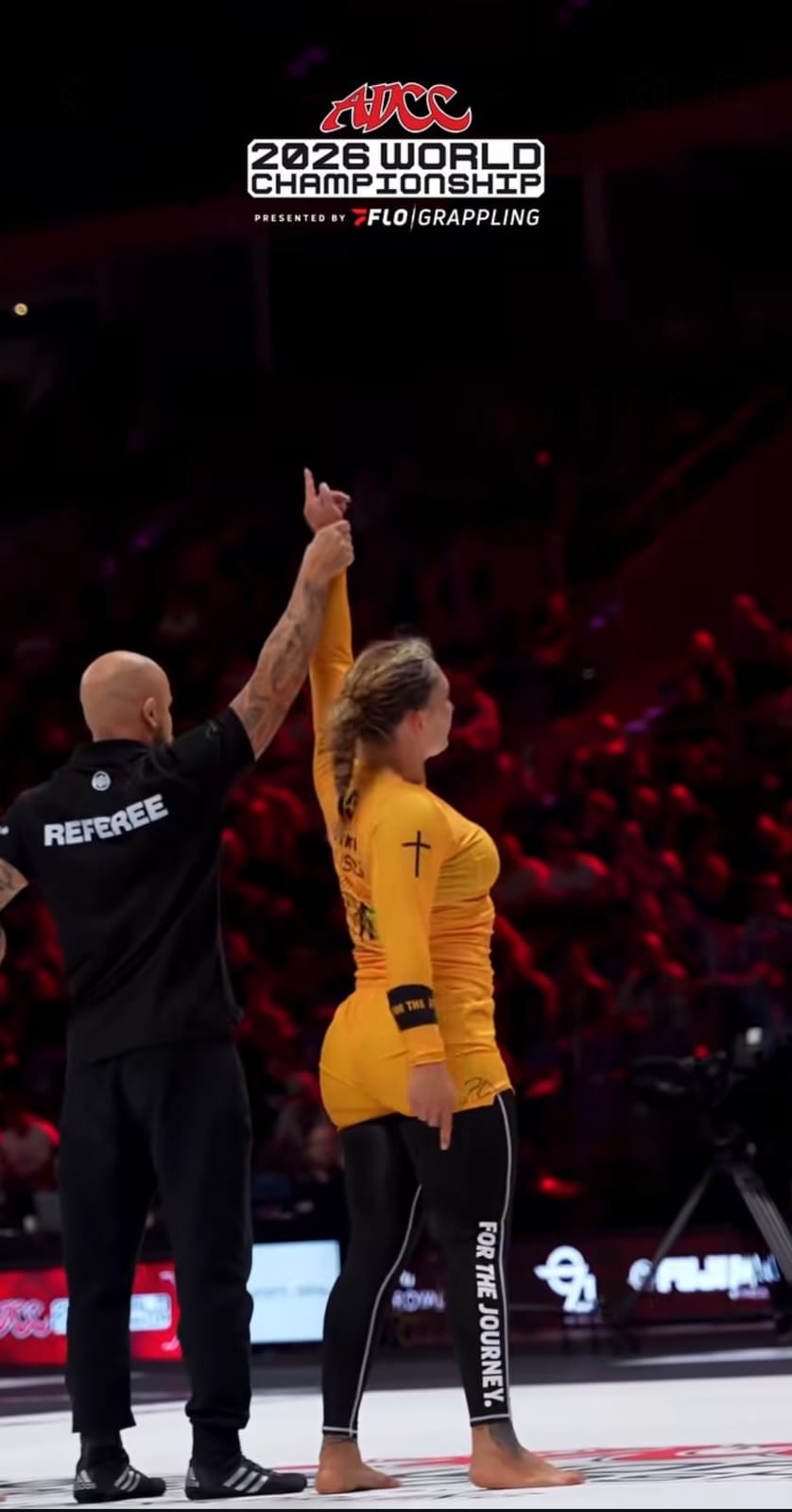
Paige Ivette Clymer, who taught at The Garden's 2.0 camp.
Paige Ivette Clymer taught at The Garden's 2.0 camp, and this weekend she won bronze in the women's +65 kg division at ADCC 2026. She opened with a kneebar over Yara Soares, dropped a close 3-0 semifinal to Anabel Lopez, then came right back and submitted Elizabeth Mitrovic in 1:52 to take third place. For Garden students, that's worth sitting with: someone who has taught on our mats just stood on the podium at the highest level of no-gi grappling in the world.
The incident
A brawl broke out after the 66 kg opening-round match between Dorian Olivarez and Bekzat Kapashov. After Olivarez won by submission, a fight erupted between Olivarez's corner and a large group of Kapashov's supporters. Gordon Ryan, who was cornering Olivarez, was caught in the middle of it and took punches from multiple people. ADCC disqualified both Olivarez and Kapashov and gave each a one-year ban, and Olivarez's father and coach was suspended for two years. Owen Jones, who had lost his opening-round match to Ryoma Anraku, took Olivarez's place in the bracket.
What Garden students can take from ADCC 2026
Watching high-level competition isn't just entertainment. It's film study. Here are five themes from the weekend that connect directly to what we train.
1. Leg locks decided matches. Jaworski's run to gold was built on lower-body attacks, starting with an ankle lock finish in the opening round. At ADCC level, athletes who can threaten the legs force opponents to defend at the expense of their own offense. The heel hook entries, ashi garami positions, and leg lock defense drills in our curriculum exist for exactly this reason. The leg lock game isn't optional in modern no-gi.
2. Wrestle-ups and standing exchanges mattered more than ever. Under ADCC rules, pulling guard without a submission attempt draws a penalty. That forced athletes to wrestle. The seated guard wrestle-ups and arm drag sequences we drill are the same entries these athletes used to get back to their feet and start their offense from bottom.
3. Guard retention kept people in matches. Athletes who could re-guard under pressure survived against stronger passers. The principle behind our supine guard retention drilling, maintaining hip alignment and frame integrity under constant pressure, was on display in nearly every division.
4. Passing chains, not single passes. The most dominant top players didn't rely on one pass. They chained passes together: torreando to leg drag, headquarters to knee cut. Pato's 6-0 quarterfinal win over Grippo was a masterclass in chained guard passing. The combination passing sequences we work in class mirror exactly this approach.
5. Composure under pressure is a skill. Maciel beat Pato by referee decision, Dzharbaev won the 77 kg final by referee decision, and the women's 65 kg final went deep into overtime before Vieira found the finish. Felipe Pena showed a different kind of composure. After losing a close decision in his weight class, he passed on the bronze match, kept his focus on gold, and won the absolute. The athletes who won weren't panicking. They stayed composed, took what was available, and trusted their conditioning. That mental game starts in training. Every round you finish while exhausted and frustrated is a rep toward the composure these athletes showed under the brightest lights in the sport.
Your move
The best way to learn from ADCC is to watch it. Pull up the replays on FloGrappling and watch a few matches from your weight class or your favorite athlete. Pick one thing you saw that you want to try: a leg lock entry, a wrestle-up, a guard retention frame. Write down your goal for your next class on your Growth page, then bring it to the mat. We train Monday through Saturday. Come roll.
Not a member yet? Check the schedule and come train with us.
Free BJJ Beginner's Guide
Positions, etiquette, training tips — everything for your first class.